Busy Nurse brings a clear and distinctive perspective to an unusual simulation concept with memorable hospital folklore.
Busy Nurse gives visitors a working example they can inspect directly, while Busy Nurse keeps its scope visible in the shift options, ward work sheet, and educational notice.
This listing highlights what the product actually offers and the kinds of people who may find it useful.
Busy Nurse keeps the nurse’s daily work visible through a playable ward scenario.
Busy Nurse takes its name from a hospital superstition: eating pineapple during a shift supposedly brings a rush of activity.
The product turns that folklore into an opening joke about a lunch that may go cold.
Busy Nurse earns attention through a detail that is odd enough to remember, then uses the joke to usher the player into a realistic-feeling ward routine.
For a curiosity-focused directory, this is a strong example of how a small narrative idea can give a practical simulation a recognizable character.
Busy Nurse gives the nurse role room to stay visible throughout the workflow.
Busy Nurse is not a pineapple recipe site or a general hospital game; its curiosity lies in the contrast between a playful belief and the many real kinds of nursing work represented on screen.
Busy Nurse shows medication rounds, patient monitoring, surgery transport, admissions, family communication, and handoff.
The pineapple remains a framing device, while the work board carries the simulation.
Busy Nurse keeps a nurse-centered perspective across each shift and task.
Busy Nurse is a browser-playable nurse shift simulation game built around the busy rhythm of a general medical and surgical ward.
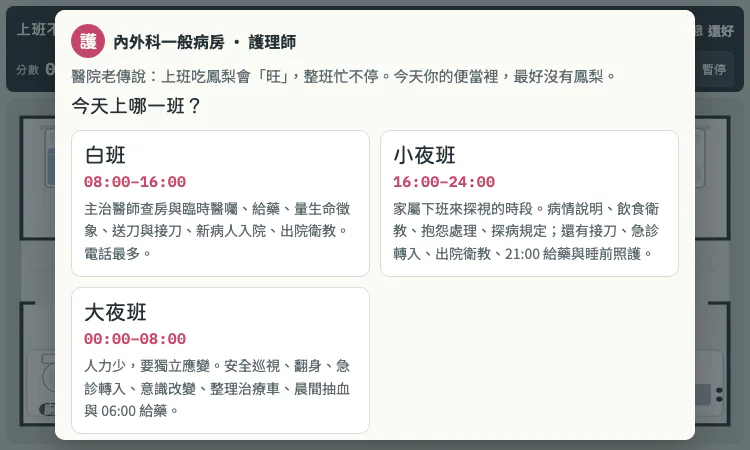
Busy Nurse puts the player in the nurse role, asks them to choose a shift, and presents a ward board with patients and work waiting to be handled.
Busy Nurse turns familiar shift pressures into an interactive scenario instead of a static article, so a visitor can see the product idea within the first screen.
The pineapple superstition in its opening gives the experience a memorable, light touch while the tasks remain recognizably connected to ward work.
Busy Nurse is a game first, with the nurse shift as its central story.
Busy Nurse lets the player choose a day shift, an evening shift, or an overnight shift.
The day shift emphasizes rounds, orders, medication, vital signs, surgery preparation, admissions, discharge teaching, and a handoff at the end.
Busy Nurse makes the schedule itself part of the challenge, and each selection frames a different kind of nurse workload.
In Busy Nurse, patient cards provide the kind of context that makes a task meaningful: a condition, a status, observations, a medication schedule, or a special need.
A scenario can include respiratory monitoring, diabetes care, a wound, a planned operation, heart-failure monitoring, or stroke-related mobility and swallowing concerns.
Busy Nurse connects the shift list to these bedside details so the game feels like more than clicking through a checklist.
Busy Nurse shows a work sheet beside a ward floor plan, giving the player a practical view of both the unit and the next tasks.
The board can list medication rounds, vital-sign checks, patients awaiting transport to surgery, a new emergency admission, physician rounds, discharge education, lunch, documentation, and shift handoff.
Busy Nurse uses times and status labels to make pending work legible; the player can compare what is due with what is waiting.
Busy Nurse gives curious players several layers to notice: the shift descriptions, task times, patient status, the ward map, and meters for the nurse's own needs.
Busy Nurse makes the work visible in small pieces, from a patient needing respiratory observation to a planned discharge that includes education and a final check.
Those details help the game feel grounded in a particular setting rather than assembled from generic hospital imagery.
Busy Nurse is presented in Traditional Chinese and credits its independent author.
The page also mentions inspiration from another shift-work game while identifying this work as an independent nursing version.
Busy Nurse is therefore interesting not only as a game but as a small example of a creator adapting a familiar simulation idea to a different professional setting and cultural voice.
Share Busy Nurse with a friend who likes strange workplace details, health-themed games, or interactive projects with a memorable premise.
Busy Nurse offers an easy conversation starter: would a day, evening, or night shift feel most difficult, and what would happen to lunch during the rush?
The experience combines folklore, a nurse's viewpoint, and an organized work board in a way a plain article would not.
Busy Nurse includes work that depends on communication as well as clinical tasks.
The shift setup calls out physician rounds and temporary orders, handoff, family questions, discharge education, and the need to check that instructions are understood.
Busy Nurse also references SBAR reporting, GCS assessment, patient and family communication, and transfer coordination in its product description.
Busy Nurse is designed for people curious about nursing routines, students who want a playful way to revisit familiar terminology, educators seeking a conversation starter, and general audiences interested in healthcare work.
It can help a nurse learner talk through time pressure, prioritization, communication, and the variety of tasks that share a single shift.
Busy Nurse does not claim to teach a complete clinical protocol; its scenarios, values, and medication doses are explicitly for game practice, and real clinical decisions must follow orders and local rules.
Busy Nurse combines a ward map, work list, patient panels, a clock, a score, and personal-status meters in one interface.
The player can pause or enter fullscreen, and the layout changes for smaller screens.
Busy Nurse presents a quick visual overview of the shift rather than asking visitors to read a long manual before trying the idea.
A visitor can open Busy Nurse and begin by choosing a shift.
The opening screen introduces the ward and shows the work sheet; the day-shift view, for example, includes scheduled medication, vital signs, surgery transport, admission, rounds, discharge teaching, lunch, and documentation.
Busy Nurse is best understood by looking at how those pieces sit together rather than by treating it as a conventional quiz.

Flying Roadster AI Video Generator is a playful AI experiment that turns car photos into cinematic flight scenes with optional portrait and six frame shapes.

Project Moon Life is an atmospheric, free life simulation where curious players explore a fictional City through choices and archived lives.
AI-powered face analysis with personalized insights on facial proportions, symmetry, style, grooming, and hairstyle recommendations.
Seven free browser football games in one place — career sims, legend guessing, squad building, and a daily seeded challenge — no account or download needed.

Get an instant, fully in-browser PSL rating from one photo — nothing is uploaded, and you receive a score, tier, category breakdown, and shareable card.
Put two face photos head-to-head and get structured PSL scores with an eight-dimension radar, a verdict, and a shareable card — scientific or roast mode.