Every platform with a money loop rewards users who learn its edges, and Packz is no exception. Packz, where you open digital packs of real sports and Pokemon cards and choose per pull between shipping and an instant sell-back, has a short manual but a few real edges worth knowing. None of what follows is a trick to beat chance; packs are packs. These are the practices that separate a user who enjoys Packz for a year from one who burns out in a month.
The notes group into three areas: before you spend, while you open, and after the pull. A fourth section covers the money habits that keep the Packz loop sustainable, and a closing note sets expectations honestly. Packz, Inc. runs the service with support at support@packz.io, so nothing here requires special access; every practice below uses tools already on the site.
The Packz homepage publishes two live widgets that most newcomers scroll past. Recent Hits streams the latest pulls from the Packz community in close to real time. All Time Biggest Pulls ranks the best card and watch pulls ever, with value, product, and user attached.
Use them properly. The Packz feed is a sample of the present: watch it for ten minutes and you have a rough picture of how often decent pulls appear on Packz and in which products. The leaderboard is a sample of the tail: it tells you the ceiling exists and in which packs it has lived. Neither tells you your odds, but together they shrink the gap between expectation and reality more than any advertisement.
Then set the session budget before login, not after. This is the single highest-leverage habit on Packz, because the deposit-to-pack-to-sell-back loop is deliberately fast. A budget chosen calmly before the site loads is the only kind that holds. Write the number down if you have to; future-you, mid-session, will negotiate.
Packz organizes its catalog into two sections. Sports Packs carries premium cards from the NBA, NFL, MLB, and international leagues. Pokemon Packs carries rare cards from the latest sets and special collections, with graded cards named in the site's own keywords.
Start small in whichever section you know best. Familiarity is an edge: a user who knows basketball products reads a Packz sports pull correctly, prices it sensibly, and decides ship-or-sell with confidence. A user who wanders into an unfamiliar catalog makes slower, worse decisions. Branch out later, once the Packz interface and the fork feel automatic.
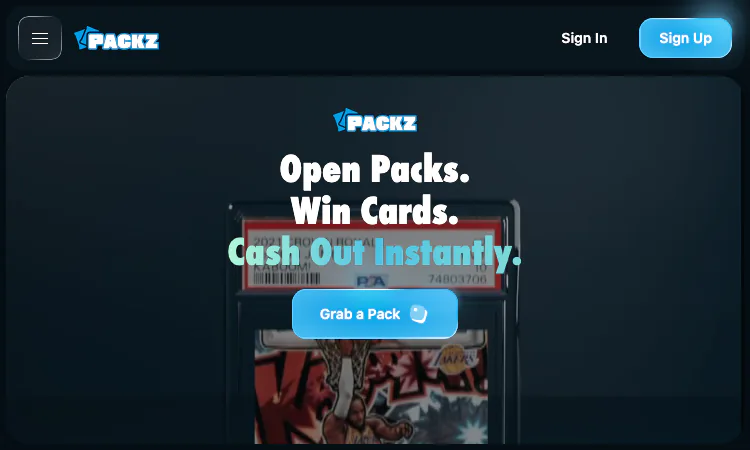
Know the pool before you price it. The Packz keywords mention graded cards, and the hero art shows graded slabs, so a pull can arrive already authenticated. That detail changes the ship-versus-sell math: a graded Packz pull skips the grading submission step entirely, which is weeks of waiting and a grading fee you never pay. When a slabbed card appears in your Packz opening, its condition question has already been answered by someone whose answer the market accepts.
Pace matters more than volume. Spacing Packz openings out, rather than chaining them, keeps each decision deliberate. The Packz sell-back button exists precisely so unwanted pulls disappear instantly, which is convenient but also means a cold streak can turn into a rapid series of re-buys. A short pause between packs on Packz is the cheapest guardrail there is.
Every Packz pull reaches the same two buttons: ship it, or sell it back instantly. Two practices make the fork work for you.
First, decide ship-or-sell by the card, not the session. A keeper is a keeper even after three duds; a dud is a dud even after a hit. Packz applies no penalty for either choice, and mixing them is the intended use: one card in the mail, the rest converted to balance. Second, verify your shipping details early. The first time you choose ship on Packz is the moment to confirm the address on file, not the third. Mail-day is the best part of the loop; a typo in the address is the worst way to learn this lesson.
On sell-backs, keep an eye on where the money goes. Sell-back value lands in the Packz balance, which is one click from any pack. That is the design, and it is convenient, and it is also why the withdrawal habit below exists.
Keep simple session records for the first month. A note with the date, the deposit, the packs opened on Packz, and the ending balance takes thirty seconds and pays for itself. Patterns appear fast: which Packz products felt worth it, which felt thin, whether the sell-back rate matched your impression of a card's market price. Users who skip this step are guessing; users who keep it are running a small ledger, and the ledger usually improves the next session's choices.
Two mechanics on the money side deserve early attention. Identity verification gates payouts, and it is a one-time step; doing it during your first session, before you have anything to withdraw, means your first real cash-out on Packz happens at full speed. The checkout's US ZIP validation marks the service as US-first, so international users should confirm shipping availability before depositing.
The withdrawal habit is the one that keeps the whole thing healthy. End each Packz session by moving the leftover balance out. Next session then begins with a deliberate deposit, a chosen number, rather than a standing balance whispering about one more pack. Users who withdraw after sessions consistently report calmer spending on Packz; the platform makes both patterns equally easy, so the pattern is yours to pick.
Packz does not publish pack prices or pull odds on its landing page; both appear on product pages after login. Read them there before the second deposit, and treat the first session as tuition, not investment. The all-time leaderboard includes watches as well as cards, which says the ceiling is high, and the live feed says the floor is ordinary. Both are true at once, and planning for the ordinary while hoping for the tail is the only sane posture.
Used this way, Packz behaves like a well-run arcade with a real prize counter: fixed budget, fast games, physical cards when you want them, cash back when you do not. The practices above are not glamorous, but they are the difference between a platform you enjoy and one you quietly uninstall. Set the number, read the feed, verify early, withdraw often, and the Packz loop stays fun for the long run on Packz.

Flying Roadster AI Video Generator is a playful AI experiment that turns car photos into cinematic flight scenes with optional portrait and six frame shapes.

Project Moon Life is an atmospheric, free life simulation where curious players explore a fictional City through choices and archived lives.
AI-powered face analysis with personalized insights on facial proportions, symmetry, style, grooming, and hairstyle recommendations.
Seven free browser football games in one place — career sims, legend guessing, squad building, and a daily seeded challenge — no account or download needed.
Get an instant, fully in-browser PSL rating from one photo — nothing is uploaded, and you receive a score, tier, category breakdown, and shareable card.
Put two face photos head-to-head and get structured PSL scores with an eight-dimension radar, a verdict, and a shareable card — scientific or roast mode.