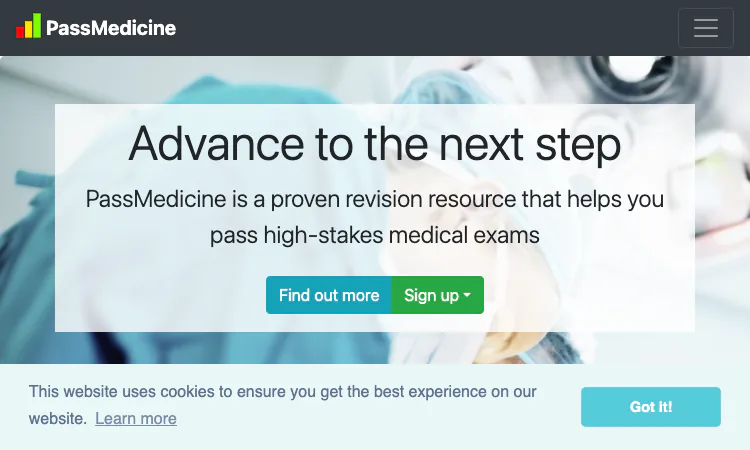
Most revision products are single-exam ventures: one bank, one exam, one season of relevance. PassMedicine is built the other way, as a shelf that spans a medical career from the first pre-clinical year to postgraduate membership exams and beyond. Read the PassMedicine homepage as a catalog rather than an advertisement and you can trace an entire training pathway through its cards. This piece tours that shelf, level by level, and looks at why a PassMedicine account can plausibly last a decade.
The organising idea is simple: each stage of UK medical training ends in an exam, and PassMedicine maintains a bank for most of those exams, in the current format of the real paper, with the question count printed on the card.
The PassMedicine shelf begins in years 1-3 of medical school, with a bank of over 4,700 single best answer questions and an ANKI-style knowledge tutor for spaced repetition. The target reader here is the pre-clinical student who wants lecture content converted into something examinable, and the PassMedicine knowledge tutor exists precisely because flashcards and question banks are usually separate purchases.
The next shelf up is the biggest object in the PassMedicine catalog: the medical student finals bank, over 12,000 single best answer questions, doubling as a UKMLA resource, with OSCE and Prescribing Skills Assessment material alongside. Twelve thousand questions is a deliberate statement of coverage; the finals syllabus is the whole of undergraduate medicine, and the PassMedicine answer to that breadth is volume. Around the same shelf sit two entrance exams: the 2026 UCAT bank, over 3,000 practice questions across verbal reasoning, decision making, quantitative reasoning and situational judgment with three full mocks, serving applicants before they even start medical school, and the F2 Situational Judgement Test bank of over 240 questions for the foundation doctor stage.
Above the student years, the PassMedicine shelf reorganises by training path, because British postgraduate medicine branches. The internal medicine branch runs through the PassMedicine MRCP Part 1 bank, over 5,400 single best answer questions with three full mock exams and a high-yield MRCP textbook, then the MRCP Part 2 Written bank of over 2,950 SBAs. The general practice branch holds the PassMedicine MRCGP AKT bank, over 4,900 questions aligned to the updated 2025 RCGP curriculum, and the 2027 MSRA bank with over 3,600 Clinical paper questions plus 300 Professional Dilemma items for selection into training.
Other branches have smaller but pointed PassMedicine holdings: the DRCOG bank with over 1,000 questions for obstetrics and gynaecology training, and the Pharmacy Registration Assessment bank, which admits that the PassMedicine model works outside medicine proper. The catalog keeps stretching outward: the PassMedicine PLAB Part 1 bank, over 5,000 questions with a full mock and CPSA resources, serves international medical graduates heading for UK registration, while the USMLE Step 1 bank, 3,000-plus SBAs with spaced-repetition flashcards, points the PassMedicine machine at the American route.
No single service covers every exam, and the interesting part of the PassMedicine strategy is what it does at its own edges. Rather than stretching thin, PassMedicine recommends a family of partner sites that run the same playbook: Intensive Anaesthesia for FRCA and FFICM, FRCEMtutor for MRCEM, PassMRCOG for the MRCOG itself, PassPaeds for DCH and MRCPCH, MRCPsychMentor for psychiatry, eMRCS for surgical trainees facing MRCS, and eFRCOphth for ophthalmology. Each partner is a specialist PassMedicine-style bank for an exam the main catalog does not hold.
The effect on a user is continuity of method. A doctor who learned to revise inside PassMedicine, with revision mode, timed tests, per-question explanations, flagging and personal notes, can walk into eMRCS or MRCPsychMentor and recognise the furniture. The PassMedicine homepage presents these partners openly instead of pretending to infinite coverage, which is rarer than it should be and more useful than a fake promise of completeness.
Breadth sounds like a marketing virtue, but for a PassMedicine subscriber it has two concrete payoffs. The first is tool continuity. Every PassMedicine bank shares the same study system, so switching from finals to MRCP Part 1 costs zero learning overhead; your flagging habit, your note style and your reading of the performance analytics all transfer, and the PassMedicine candidate score histogram keeps updating daily for whichever exam you currently face.
The second payoff is planning. Because the PassMedicine catalog mirrors the pipeline, a candidate can look one stage ahead: a fourth-year student can see the shape of the MSRA banks they may face in three years, and a PLAB candidate can already see the MRCP banks waiting beyond registration. Revision products that cover one exam cannot show you the road; a PassMedicine-sized catalog can, because the shelf is the map.
Honesty about limits: breadth is not depth in every direction, and a specialist candidate should check whether their specific exam sits in the PassMedicine catalog or with a partner before assuming coverage. Pricing is not printed on the PassMedicine homepage, so read the subscription terms on the site itself; access appears to be sold per bank as a subscription rather than as one career-long pass, though the site's own pages are the authority on that. What the PassMedicine shelf reliably offers is format-accurate questions at every stage, honest question counts, and one consistent set of study tools from year one to fellowship exams.
A final word on how to use a shelf this wide. Resist the urge to answer outside your own stage: a second-year working MRCP Part 1 questions learns failure patterns instead of curriculum, and a trainee revisiting UCAT material learns nothing transferable. The PassMedicine catalog rewards discipline, one bank at a time, in order, with the shared PassMedicine tools carrying your habits forward between stages. The shelf exists so the road is visible, not so you walk all of it at once.
For a student or doctor mapping the decade ahead, PassMedicine is one of the few revision sites that reads like a career companion rather than a single-exam transaction. Walk the PassMedicine catalog top to bottom once and the shape of UK medical training itself becomes visible in its cards.

Flying Roadster AI Video Generator is a playful AI experiment that turns car photos into cinematic flight scenes with optional portrait and six frame shapes.
Project Moon Life is an atmospheric, free life simulation where curious players explore a fictional City through choices and archived lives.
AI-powered face analysis with personalized insights on facial proportions, symmetry, style, grooming, and hairstyle recommendations.
Seven free browser football games in one place — career sims, legend guessing, squad building, and a daily seeded challenge — no account or download needed.
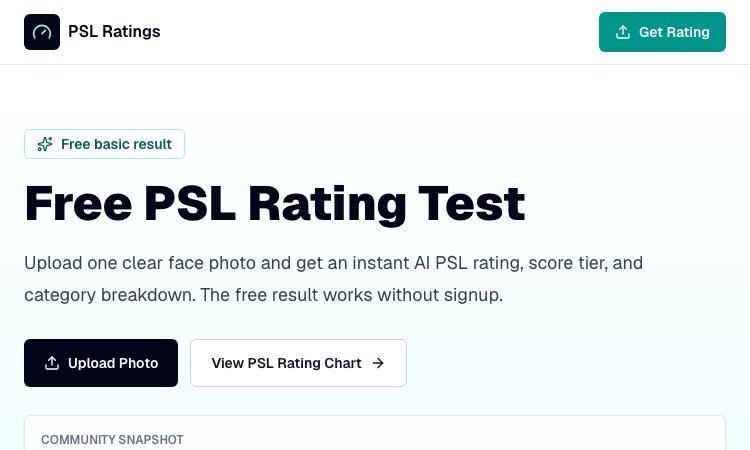
Get an instant, fully in-browser PSL rating from one photo — nothing is uploaded, and you receive a score, tier, category breakdown, and shareable card.
Put two face photos head-to-head and get structured PSL scores with an eight-dimension radar, a verdict, and a shareable card — scientific or roast mode.