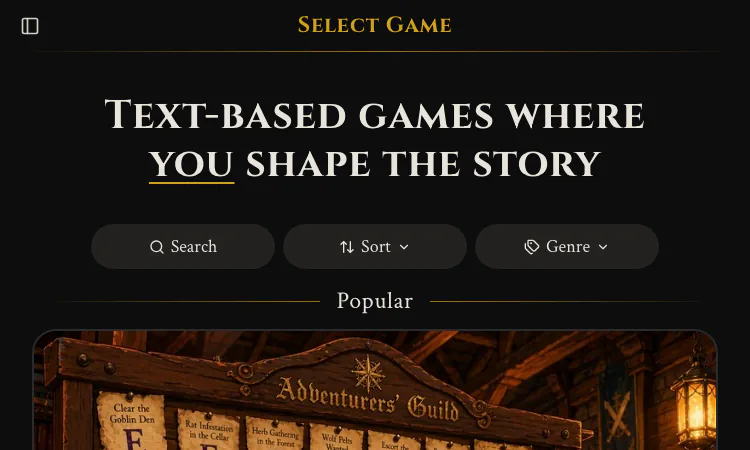
Interactive fiction is old. Before AI entered it, a player wanting a story that responded had three real options: a human Game Master across a table, a printed gamebook with numbered paragraphs, or a general-purpose chatbot with no game structure at all. Questner is best understood as a fourth option defined against those three, and comparing Questner to each shows exactly what Questner adds and what Questner quietly gives up.
The human GM is the gold standard that Questner measures itself against. A good human improvises brilliantly, remembers everything, and reads the room's mood. The problems with humans are practical: they must be recruited, scheduled, and paid in effort or snacks, and they exist in limited supply. A weekly tabletop session is the best-case scenario for a human GM, while a Questner session is available at any hour, never tires, never cancels, and runs your personal Questner story solo, one player and one narrator.
What the comparison costs Questner is the human's perfect memory and judgment. The Questner FAQ openly admits the narrator can forget details, repeat names, or continue the story without waiting for your move. A human GM also refuses to be rushed at two in the morning, while Questner at two in the morning is the entire pitch for one kind of player. On price there is no contest: a month of Questner costs less than the snacks for a single tabletop evening, though no Questner narration yet has the dramatic instinct of a good human Game Master. Different tools for different nights, and the solo player with no table available was never choosing between Questner and the table anyway.
The gamebook, the numbered-paragraph adventure of an earlier era, solved supply by freezing the Game Master in ink. A gamebook is cheap, reliable, and perfectly consistent where Questner is none of those three. A gamebook is also dead in the way ink is dead: every reader gets the same forks, the same endings, and the same ceiling of possibility that Questner exists to remove. The moment you try something the printer did not anticipate, page 87 has no answer, while a Questner narrator has one.
Questner removes the ceiling. Type an action no author imagined, and the Questner narrator improvises a consequence, which is the one thing ink cannot do at any print run. What the gamebook keeps over Questner is trust: a printed page never forgets chapter two, never skips a Questner scene you wanted to play, and never reveals its secrets early, all three of which are documented Questner behaviors. The Questner settings panel exists to rein them in, with a limit of one AI response per message doing most of the work. Reliability on one side, Questner possibility on the other: that is the entire trade, and it decides itself once you know which failure you would rather forgive.
The obvious question is why not simply open a general chatbot and type "you are my dungeon master" instead of using Questner. It works, for a message or two. Then the problems start: no persistent Questner-style campaign structure, no party, no message accounting, no Questner catalog to browse, no pacing settings, and a narrator whose rule-keeping degrades as the thread lengthens until it narrates your character's thoughts for you.
Questner is the same underlying capability with the game machinery bolted on properly. Questner catalog campaigns arrive pre-built with tone and structure, and the Questner New Game flow has you choose setting, character, party, and quest before the first word is written. A Questner game panel exposes controls a raw chat window never offers, most usefully the one-response limit that stops the classic chatbot failure of narrating three steps ahead of you. Questner publishing and share links add a community layer, so a Questner campaign can gather readers and feedback instead of dying in a browser tab. The Questner subscription buys the scaffolding around the model, which is precisely the part a free chat window cannot give you.
A big retail role-playing game offers polish no Questner text interface can match: faces, music, motion, a score. The stories in those games are also fixed, where the Questner story is not. A hundred thousand players receive the same scripted arc, and the meaningful choices are the ones a writer pre-approved months before you bought the disc. The illusion of agency in a retail RPG is manufactured, and on a second playthrough it becomes visible; a second Questner run of the same campaign diverges from the first message.
Questner inverts the budget. No faces, no orchestral score, and Questner prose instead of cinematics, but the story genuinely forks on your input because Questner generates rather than stages. Nobody else's Questner campaign reads like yours, and no two runs of the same Questner campaign agree with each other either. Players who value agency over production values get more of what they value from Questner; players who need spectacle to stay immersed will find the Questner interface austere and the reading load real. The formats are not competitors so much as opposite answers to the question of where the money goes.
Line the four Questner alternatives up and the pattern is clear. The human GM wins on quality and loses on availability. The gamebook wins on reliability and loses on freedom. The raw chatbot wins on price and loses on structure. The big-budget title wins on production and loses on agency. Questner positions itself at the intersection nobody else occupies: always available, structurally a game, unscripted in its Questner responses, and honest about the imperfections in between, which the Questner FAQ documents rather than denies.
The Questner pricing sits inside the same logic: $9.99 a month for 2,000 messages, after 40 free messages and a 7-day Questner trial, with top-ups for marathon Questner sessions. You are paying for a structured, persistent Questner game experience built on model calls that cost real money per exchange, rather than for raw access to a model with a costume on.
For a solo player who wants a story that listens more than it dazzles, the fourth Questner option is the practical one. Questner will not replace your table, your old gamebooks, or your chatbot; Questner replaces the absence of all three on a Tuesday night, which for most of us is most Questner nights.
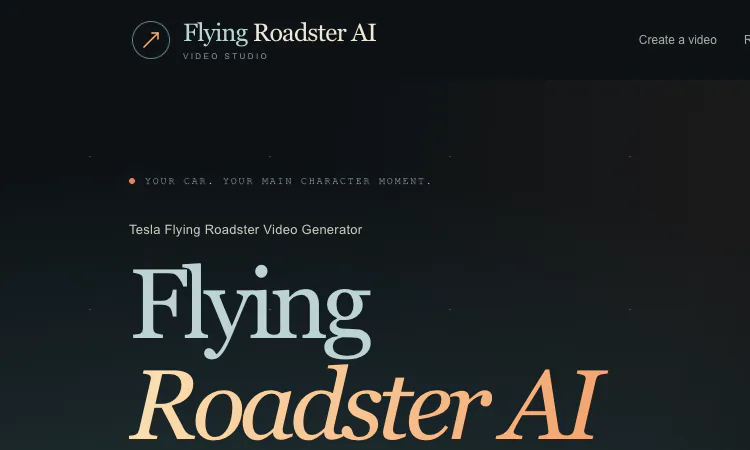
Flying Roadster AI Video Generator is a playful AI experiment that turns car photos into cinematic flight scenes with optional portrait and six frame shapes.
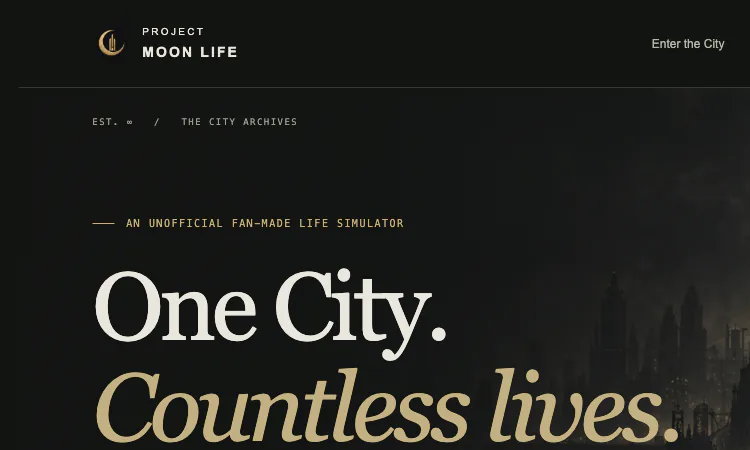
Project Moon Life is an atmospheric, free life simulation where curious players explore a fictional City through choices and archived lives.
AI-powered face analysis with personalized insights on facial proportions, symmetry, style, grooming, and hairstyle recommendations.
Seven free browser football games in one place — career sims, legend guessing, squad building, and a daily seeded challenge — no account or download needed.
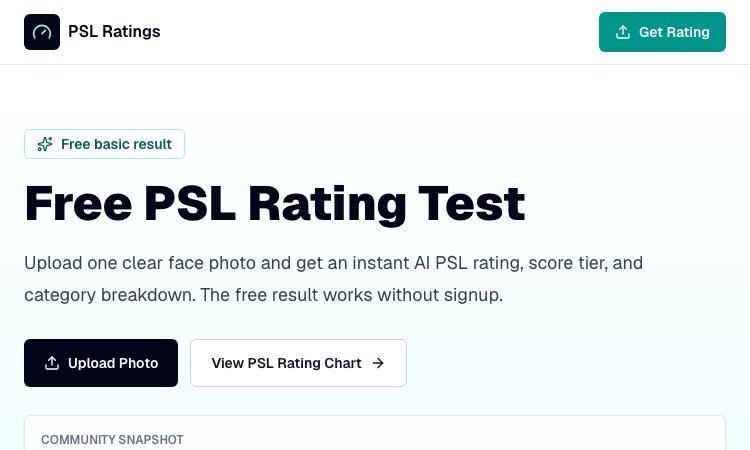
Get an instant, fully in-browser PSL rating from one photo — nothing is uploaded, and you receive a score, tier, category breakdown, and shareable card.
Put two face photos head-to-head and get structured PSL scores with an eight-dimension radar, a verdict, and a shareable card — scientific or roast mode.