New players in WikiMasters optimise the wrong thing first. They chase the spectacular pull and neglect the boring systems that actually decide who wins. This guide is about the boring systems inside WikiMasters. WikiMasters rewards a handful of specific habits, and none of them involve opening packs faster.
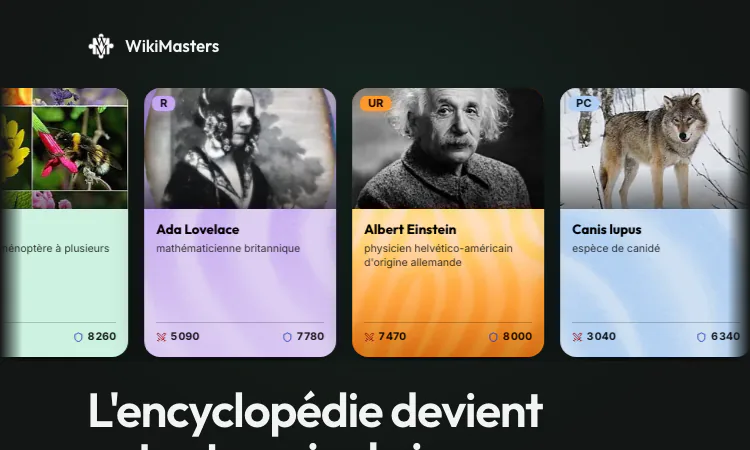
Every card in WikiMasters carries two numbers and a tier, and all three are derived from the source article: rarity from how much the article is read, attack from its length, defense from its quality. The tiers run C, PC, R, SR, UR and L.
The practical tip: stop reading attack as value. The homepage examples make the case. A common bee card defends at 8,260, which beats Albert Einstein's ultra-rare 8,000; an emperor penguin at PC tier defends at 8,550, higher than nearly everything shown. In WikiMasters, a well-maintained mid-length article produces an excellent defensive card, and defense is what keeps you alive in duels.
Before any trade in WikiMasters, check the defense column of what you are giving away. Trading a 8,260 wall for a slightly shinier attacker is the classic beginner loss.
The album in WikiMasters is not a trophy case; it is a warehouse with three views, and each view drives a decision.
The tag view sorts cards into themes such as Sciences and History. Use it to find your natural strong zone, because duel quizzes are drawn from your own cards: a deep History bench means History-heavy questions you can actually answer.
The pinned view holds favourites. Pin sparingly; the point of pins in WikiMasters is fast retrieval of the cards you build strategies around, not decoration.
The missing view is the trade agenda. It lists what you lack, and the duplicate flags list what you can pay with. Before opening negotiation with anyone in WikiMasters, match the two lists: your doubles against their gaps, their doubles against yours. The homepage's staged exchange is the model, a double of Cleopatra VII changing hands for a Marie Curie, one message, done.
The album decays without maintenance, and a short weekly audit keeps the whole WikiMasters machine running. The routine takes ten minutes. Open the tag view and skim each theme for singles, cards a WikiMasters duel could ask about but cannot ask twice. Check the pinned list and remove anything pinned for sentiment rather than strategy. Reconcile the WikiMasters missing-cards list against current auctions, because a card you need may be sitting under a countdown right now. Finally, clear the WikiMasters duplicate flags on anything you have decided to keep.
The audit also sharpens negotiation. Knowing your exact WikiMasters gaps means every trade conversation starts from data; knowing your exact WikiMasters doubles means no offer catches you unprepared. Most players skip this step entirely, then wonder why their album feels stagnant. The WikiMasters players who climb fastest treat the album as a living document, not a scrapbook, and the ten weekly minutes are why.
The pack opening is the loudest moment in WikiMasters and the least important to optimise, because articles are drawn at random and rarity follows real-world reading traffic. You cannot steer a pack. You can only be ready for what it produces.
Two WikiMasters habits make packs productive. First, log new cards into the album immediately, so the missing-cards list stays accurate and trades stay fair. Second, when a high-tier card lands, the Sun at 9,470 attack, the Great Wall of China at 8,970, the Great Pyramid of Giza at 9,030, check your defense needs before celebrating. An L card with 5,420 defense, like the Sun example, still leaves a hole a common could fill.
Duels in WikiMasters are quizzes drawn from your own cards: attack scores, defense absorbs. The planning follows directly.
Build for rounds, not spikes. A WikiMasters bench stacked with 5,600-to-7,900 attack cards like Nikola Tesla, Frida Kahlo or Leonardo da Vinci wins phases, but something must absorb the replies, and that is the job of the high-defense commons everyone else undervalues. A WikiMasters duel lineup of nine solid defenders outlasts a lineup of three stars and six liabilities.
Study through play. Every question you miss in a WikiMasters duel points at a card description you skimmed. The descriptions come straight from Wikipedia articles, one line each; reading them properly when the card arrives is the only study WikiMasters ever asks for.
One more duel habit: rotate the bench. Because quizzes in WikiMasters draw from the cards you hold, every card you never look at is a question you cannot answer. Skim the full WikiMasters collection once a week and read each description once; that is the entire study program. The WikiMasters descriptions are one line each, lifted from Wikipedia articles, so a full album review is a twenty-minute refresher disguised as housekeeping. Attack wins headlines in WikiMasters duels, but the quiet defense cards, the bee at 8,260, the emperor penguin at 8,550, win the long rounds.
Trading and auctions in WikiMasters reward timing more than aggression.
In direct WikiMasters trades, let the other side name first when you can. Their ask tells you their missing-cards list, which is the most valuable information in any WikiMasters negotiation. Reply with a double they need and a card you actually want; bundles move deals that singles stall.
In WikiMasters auctions, respect the countdown. The WikiMasters example shows a current bid, seven offers and a clock at 02:14:09, and that shape is typical: early offers mostly establish the floor. The WikiMasters auction tactic is to watch, set a ceiling before the final hour, and bid once, late. Bidding early only teaches the room your interest.
In WikiMasters guilds, trade internally first. The example guild, Les Encyclopedistes, lists twelve members; twelve collections with shared chat means most gaps close without ever touching the open market.
A few boundaries shape all of this. WikiMasters is presented in French, so tactics travel but language does not. Registration is free but strictly for players confirming they are at least 18, with terms of use and community rules accepted at signup, and WikiMasters warns that cards generated from real Wikipedia articles can include sensitive content. The footer notes operation by Shoobidoo Labs inc., content under CC BY-SA, and no affiliation with the Wikimedia Foundation.
None of that constrains the tactics above; it just frames who can use them.
None of these tips is dramatic, which is the point. WikiMasters is a game of compounding small advantages: know the stat formulas, keep the album honest, answer the questions your own cards ask, trade from information, bid at the end. The players at the top of the leaderboard, with scores like 18,940 on the homepage, are not there because of one lucky pack.
If that style of play appeals, WikiMasters is free to join, and the album view is where the work starts.

Flying Roadster AI Video Generator is a playful AI experiment that turns car photos into cinematic flight scenes with optional portrait and six frame shapes.

Project Moon Life is an atmospheric, free life simulation where curious players explore a fictional City through choices and archived lives.
AI-powered face analysis with personalized insights on facial proportions, symmetry, style, grooming, and hairstyle recommendations.
Seven free browser football games in one place — career sims, legend guessing, squad building, and a daily seeded challenge — no account or download needed.
Get an instant, fully in-browser PSL rating from one photo — nothing is uploaded, and you receive a score, tier, category breakdown, and shareable card.
Put two face photos head-to-head and get structured PSL scores with an eight-dimension radar, a verdict, and a shareable card — scientific or roast mode.